> For the complete documentation index, see [llms.txt](https://docs.inogic.com/llms.txt). Markdown versions of documentation pages are available by appending `.md` to page URLs; this page is available as [Markdown](https://docs.inogic.com/deduped/configuration/deduped-scheduled-job/configuration-steps-in-windows-task-scheduler.md).
# Configuration steps in Windows Task Scheduler
* Download the latest version of the DeDupeD Scheduler Tool and extract the files.
* Now, on your system, **open the Task Scheduler application**
• Go to **Task Scheduler Library**.
\
• Navigate to **Actions** and click on **Create Task**.
\
• The configuration window will pop up. Here, select the **General** tab.
\
• Fill in the necessary details of Name and Description as shown in the image below and click Ok:
* Now, in Task Scheduler, go to the **Triggers** tab.
* Click on New to create a **new trigger** action.
* Under Settings, choose your preferred options for how the scheduler should run and click Ok.
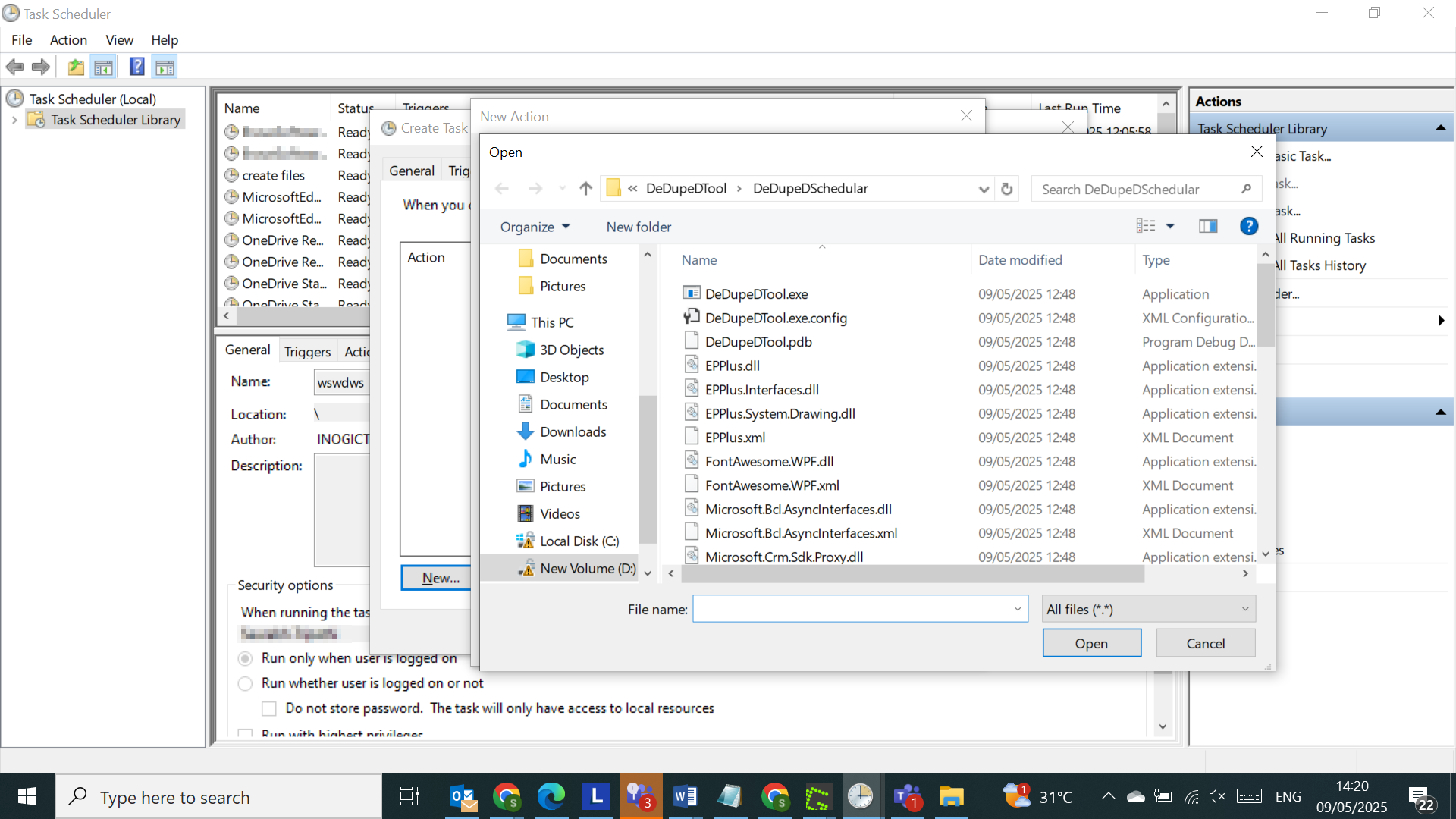
* Now, in Task Scheduler, go to the **Actions** tab.
* Click on New to create a **new action**.
* In the Actions tab, specify the action that the scheduler should perform.
* *Click on New and Select Start a Program.*
* Program/script: Select the **.exe file** of the DeDupeD tool
**Add Arguments**
* In the Add Arguments field, enter the required arguments.
* Ensure that the arguments are passed in the exact format as specified in the provided example/template.
* Verify the syntax before saving to avoid execution errors.
* To create argument ids, [click here](/deduped/configuration/deduped-scheduled-job/azure-client-id-and-client-secret-configuration.md).
* Now, in Task Scheduler, go to the Conditions tab.: Here, specify the conditions that, along with the trigger, determine whether the task should run. The task will not run if any condition specified here is not true.
* Now, in Task Scheduler, go to the **Settings** tab.
* Select the required settings and click Ok.
Scheduled Job will be listed in Task Manager as given below:
After the scheduler finishes running the job, the results will be automatically saved.
The user can view them under **DeDupeD Job Runs.**
Click on the desired Job Run result.
The detailed statistics for that run will be displayed.
**Job Execution and Result Handling**
Once triggered by the Task Scheduler, the DeDupeD Tool will:
* Execute the configured duplicate detection job.
* Create a Job Run and corresponding Job Results in CRM.
* Notify the configured users via email upon completion.
You can access the Job Result record in CRM and click Show Duplicates to review and take further action. Use the Assign button to delegate records to other users for review or merge confirmation.